
iPSC transfection with low stress.
A drop-in replacement for today’s lipid reagents in induced pluripotent stem cells: the same workflow, with much more expression, and cells that stay pluripotent.
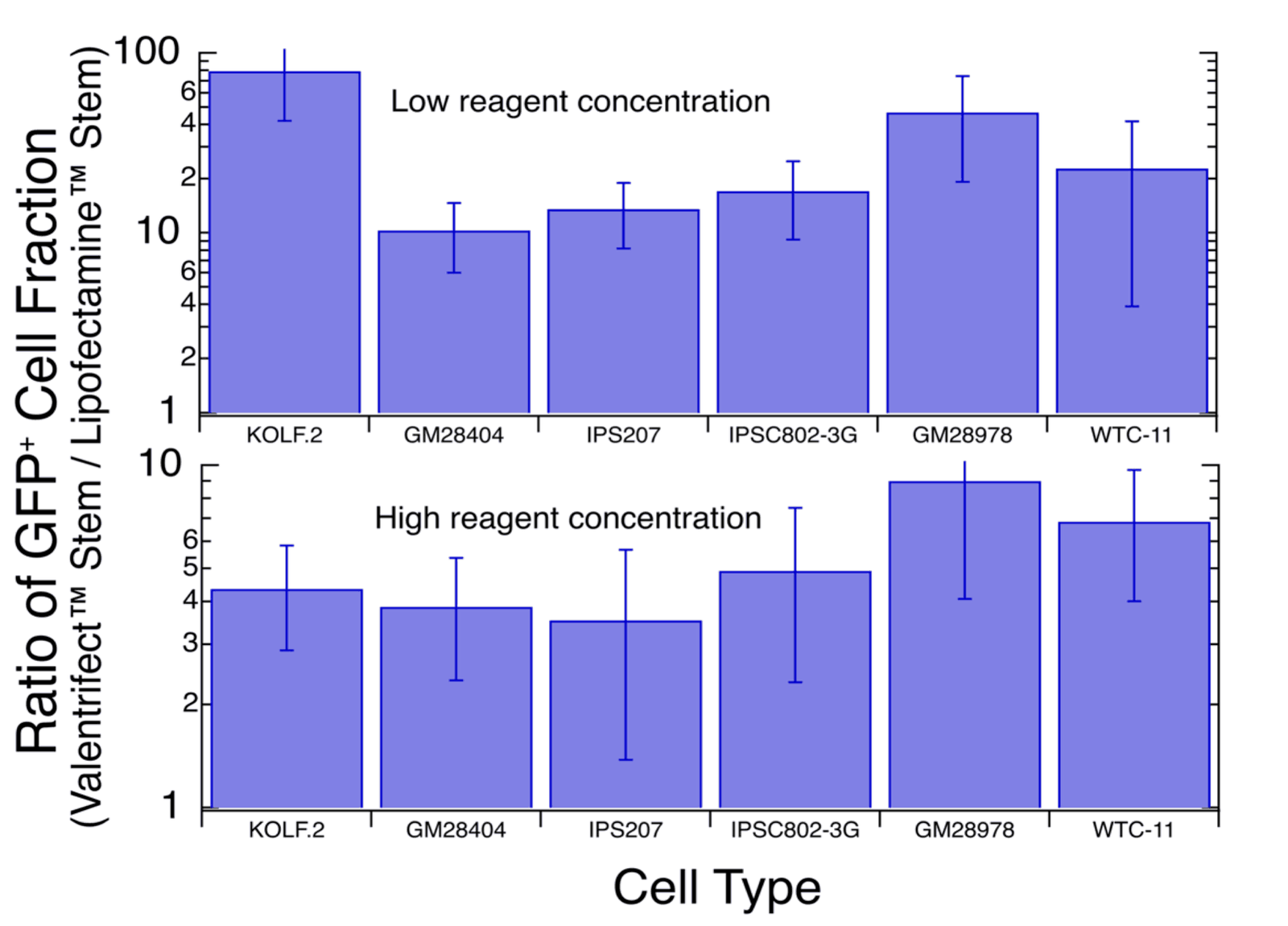
Higher expression in every iPSC line we tested.
Six human iPSC lines were transfected with GFP mRNA using Valentrifect™ Stem or Lipofectamine™ Stem, each at two reagent amounts.
Transfected iPSCs stay pluripotent and can still differentiate.
Core pluripotency factors retained
No shift vs. untransfected controls and no spontaneous differentiation, the same result as Lipofectamine™ Stem.
Mesoderm
100%of GFP-positive cells differentiated to mesoderm.
Ectoderm
ObservedGFP-positive cells differentiated to ectoderm (abbreviated protocol).
Pluripotency by flow cytometry (OCT4, SOX2, NANOG) in GFP-positive cells; lineage markers by flow cytometry after directed differentiation.
All iPSC measurements on this page were made by Forte Biosciences.
Gentle on cells. Strong on expression.
- Cell viability above 90% in all conditions tested.
- No interferon or stress response at 6 h or 24 h across five marker genes, matching untreated cells and Lipofectamine™ Stem.
- OCT4, SOX2 and NANOG retained in GFP-positive cells, with no shift versus untransfected controls and no spontaneous differentiation.
- Transfected cells still differentiate on demand: 100% of GFP-positive cells differentiated to mesoderm, and ectoderm differentiation was also observed (abbreviated protocol).
Independent testing by Forte Biosciences, including viability. KOLF2 hiPSCs transfected with GFP mRNA; RT-qPCR for stress markers; flow cytometry for pluripotency (OCT4, SOX2, NANOG) and, after directed differentiation, lineage markers.
What you get.
See it on your own iPSCs.
We provide evaluation samples so you can compare Valentrifect™ Stem with your current reagent at your own bench.
For research use only. Not for diagnostic or therapeutic use. Lipofectamine™, MessengerMAX™ and ExpiFectamine™ are trademarks of Thermo Fisher Scientific, which is not affiliated with Valentris.